
A WordPress locality setting and the optimisation of Hungarian language websites a key step to achieving a successful online presence. You can learn how to you can fix it improve your website's performance to perform better in search engines and for visitors user-friendly provide an experience. In this post, you'll discover the key strategies and tools to help you increase the effectiveness of your website. Don't ignore these suggestions if you are serious about digital growth!

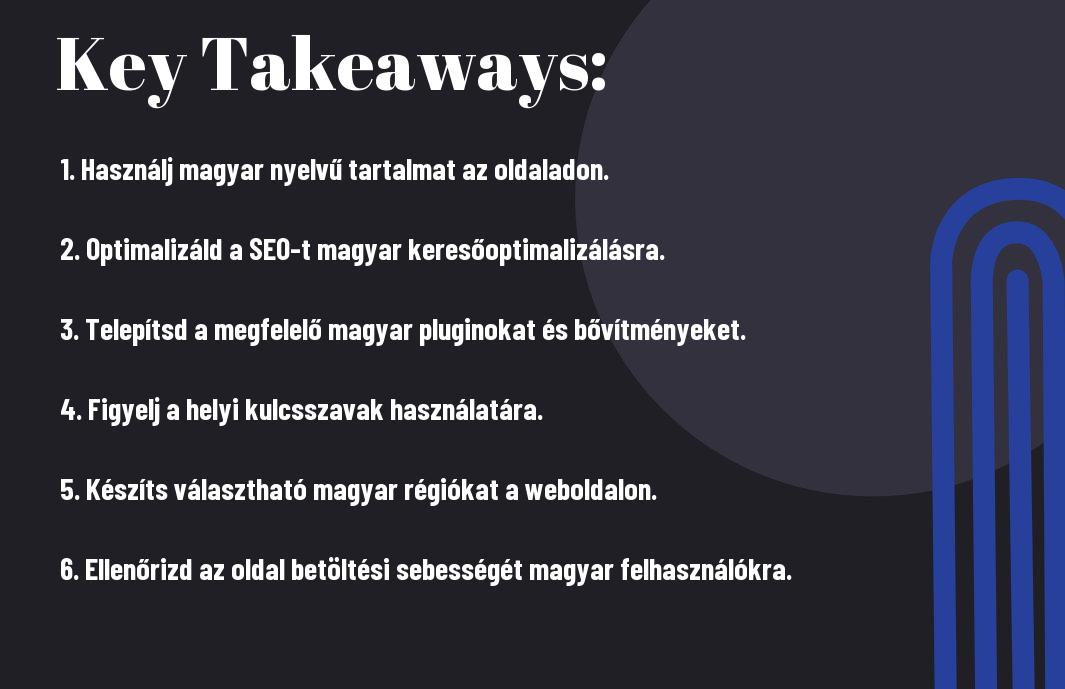
Key takeaways:
- To optimise WordPress websites, it is important to use the right SEO tools and plugins, such as Yoast SEO, to help optimise content and metadata.
- For local search engine optimisation, it is important to use the right keywords that are relevant to the Hungarian audience and to provide local information such as address and contact details.
- The speed of your website is key to the user experience, so it's worth paying attention to optimising images and caching.
The importance of WordPress local presence
The local presence of WordPress essential for local businesses as it helps them to reach potential customers. Proper optimization will allow your website to stand out from the competition and increase your online visibility. In addition to search engine optimization (SEO) improves ranking, local presence increases confidence also among potential customers.
Local SEO Basics
The basics of local SEO include using local keywords, creating and optimising your Google My Business profile, and being featured in local directories. These steps include help your website ranking in local searches and make it easier for potential customers to find you. Optimised content and local backlinks also play a key role.
Understanding the target audience
Understanding your target audience is essential to developing an effective local marketing strategy. You need to know who your potential customers are, what their needs are and how they find your products or services.
If you thoroughly understand the your target audience behaviour and needs, you can more easily tailor your content to meet their expectations. Use market research and analytics to map the habits of your audience. This data will help you to better attract potential customers, thereby increasing your business results. With targeted messages and the right keywords, you'll go as far as actually reaching the audience you want.
Website optimisation
Website optimisation is key to ensuring that visitors can easily find your content. Using the right techniques will help to in search engine optimisation, improving your website's ranking in search engine results. Don't forget to consider the user experience, as good design and the fast loading time are essential for success.
Keyword research and application
Keyword research is the first step in optimising your website. It is important to relevant keywords choose the ones that are relevant to your target audience. Use keyword research tools to find out what terms people are searching for so you can increase traffic.
Content development and localisation
During content development and localisation, the text on your website is your target audience you need to adapt it to your needs. This means not only translation, but also taking cultural differences into account. If the content is relevant and understandable, it will significantly improve the user experience and therefore the success of your website.
Content development and localisation make sure that the text is clear, concise and informative. It is also important to take cultural background into account, as this will help visitors to feel that your website is really deal with them. Personalised content increases user engagement and conversion rate, so it is worth doing a thorough job in this area.
Technical SEO aspects
A technical SEO is key to the success of your website, as it is the foundation on which you can build your content. It is important that your website's structure, code and performance are optimised for search engines. Don't forget to check your URL structure, meta tags and HTML schemas as these will all affect your rankings.
Website speed optimisation
The speed of your website critical factor both in terms of user experience and SEO. Slow sites not only test the patience of visitors, but can also be ranked lower by search engines. Use tools like Google PageSpeed Insights to identify slowing factors and improve load times.
Mobile-friendly design
Nowadays it is essential that your website mobile-friendly as more and more users browse the internet from their smartphones. Responsive design helps visitors to use your website seamlessly on any device, which also helps SEO improvements.
A mobile-friendly design is not just a matter of aesthetics: to improve the user experience, pay attention to font size, button size and image optimisation. It's important that your website is responsive, so that it automatically adapts to different screen sizes, increasing engagement and reducing bounce rates. Don't overlook mobile optimisation, as Google's ranking algorithms also favour mobile-friendly websites.
Local link building strategies
Local link building is key to search engine optimisation, as it helps to improve the the visibility of your website in local searches. It's important to gather local resources that are relevant to your business, so that you can quality link get. Using social media, working with local businesses and promoting upcoming events can all help build your local link profile.
Local business partnerships
Building local business partnerships is not only about interesting links but also improves your local credibility. By working with other businesses of a similar size and industry, you can open up new opportunities and exchange links so you can support each other's growth.
Catalogues and social platforms
A catalogues and the community platforms can be effective tools for local SEO. Getting your business listed in the most popular online directories, such as Google My Business, can help to your visibility to increase. In addition, an active presence on social media platforms can help you reach customers and generate new links.
It is important to note that the catalogues and social platforms are not only useful for link building, but also for brand building and the development of customer relations. Make sure you are accurate and up-to-date information about your business, as this will increase trust and credibility in the eyes of potential customers. Remember that activating feedback and reviews on these platforms can also significantly influence decisions.
WordPress plugins for local SEO
WordPress plugins play a key role in local SEO optimization, as they allow you to improve your website's visibility in local searches. Advanced plugins like local SEO tools can help potential customers find your business more easily. Choosing and using the right plugins is essential to getting the best results in search engines.
Overview of popular extensions
Popular plugins for local SEO include Yoast SEO, which is easy to use and provides the tools you need to optimise your local searches. In addition, you may also find the Local SEO by Yoast and WP Local Plus plugins useful, as they provide detailed data and settings to help you increase your website's local visibility.
Effective use of extensions
To use plug-ins effectively, you need to familiarise yourself with the settings they offer. It is important to read the documentation carefully for each extension, as this can help you to make the most of the features that suit you best. Optimising your plugin settings will not only improve your website's SEO, but also increase your customer reach.
Find out how increasing the settings of your plugins affects your ranking! For example, if you use keywords, titles and meta descriptions correctly, can significantly improve your local search results. However, it is recommended that you regularly update the extensions you use to ensure you always have access to the latest features and security updates.
Monitoring and analysis of results
To ensure the success of your website optimisation, it is important to track and analyse your results. This will not only help you measure progress, but also identify areas where further improvements are needed. Regular analysis will help you to continuously refine your SEO strategies and achieve the best results with your target audience.
Important indicators
For a successful follow-up, pay attention to the key indicators, such as traffic, bounce rate and conversion rate. This data will help you evaluate the performance of your website and understand how users are responding to your content. By monitoring these metrics on an ongoing basis, you can more easily identify areas of success and areas of underperformance.
Selection of analysis tools
The choice of analytical tools is key to understanding the performance of your website. Platforms such as Google Analytics or the SEMrush, provide detailed statistics and insights into user behaviour, allowing you to make informed decisions. Choose tools that meet your goals and help you make simple sense of the data.
When choosing the right analytical tools, it is worth taking into account the the size of your website and the your goals. If your goal is to track detailed traffic and user behaviour, you can use the Google Analytics is the best choice. But if you need specific SEO analysis, choose tools such as Ahrefs or the SEMrush. These tools not only track traffic and rankings, but also provide detailed analysis of your competitors' performance, so you can focus your strategy even more.
WordPress localization - Optimization of Hungarian language websites
If you want your website to perform well in the Hungarian market, it's important to consider WordPress localization settings. Optimise your content in Hungarian and use the right keywords to make it easy for potential visitors to find your site. Also, don't forget local SEO techniques, such as Google My Business registration, which will help increase your visibility. This approach will help you effectively reach your target audience and improve your online presence.
FAQ
Q: Why is WordPress localization important for Hungarian language websites?
A: WordPress localization helps optimize Hungarian-language websites so that both browsers and users find relevant content. Taking localism into account increases the effectiveness of search engine optimization (SEO) by presenting Hungarian users with understandable and relevant information, thus improving traffic and visitor experience.
Q: How can I optimize my WordPress website for Hungarian content?
A: Optimizing a WordPress website for Hungarian content involves several steps. First, make sure that the website language is set to English in the settings. Second, use relevant keywords in Hungarian content and create quality text that targets your local audience. Finally, pay attention to the URL structure and meta data to ensure that they also reflect Hungarian language content.
Q: What tools do you recommend using to optimize your WordPress site?
A: There are several tools that can help you optimize your WordPress site. It is recommended to use the Yoast SEO or All in One SEO Pack plugins, which allow easy management of meta data and keywords. Also, you may want to use Google Analytics and Google Search Console to monitor your website performance, which will help you optimize.






 English
  Hungarian
  German
  French
  Spanish
  Italian
  Dutch
Dutch  German (Austria)